
2026 FIFA World Cup Final Stadium: Everything You Need to Know
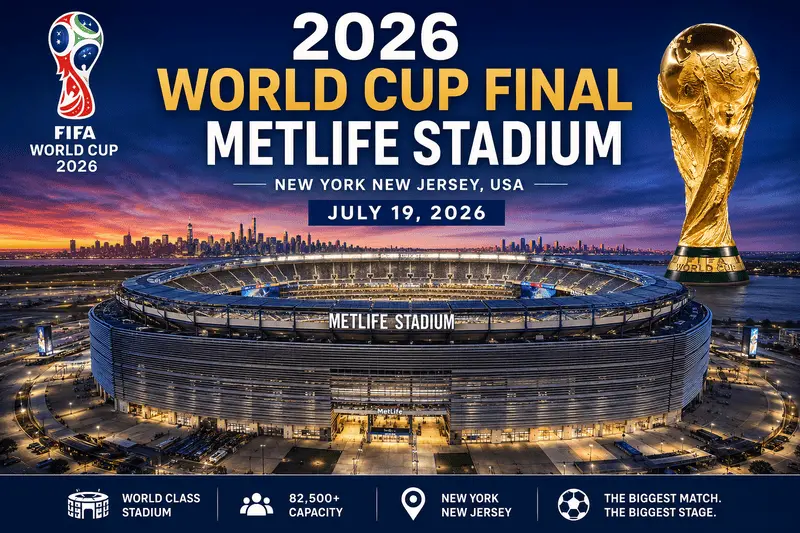
The 2026 FIFA World Cup is not just another tournament — it is a historic reimagining of the world’s most beloved sport. For the first time ever, three nations are sharing hosting duties: the United States, Canada, and Mexico. Spread across 16 host cities, 48 teams, and 104 matches, this is the largest World Cup in history, and it is coming to North America for the first time in 32 years.
Every World Cup builds toward a single defining moment — the Final. That one match where nations collide, legacies are cemented, and football history is written. Billions of eyes around the globe will be fixed on a single stadium, a single pitch, a single trophy.
For 2026, that moment arrives on July 19, 2026. And the stage has been set at one of the most iconic sporting venues in the world — a stadium that sits in the shadow of the New York City skyline and has already hosted some of the biggest events sport has ever seen.
Whether you are lucky enough to have a ticket in hand, planning your trip to the New York–New Jersey region, or simply want to understand the full story behind the venue, this guide covers everything you need to know about the 2026 FIFA World Cup Final stadium.
Which Stadium Will Host the 2026 FIFA World Cup Final?
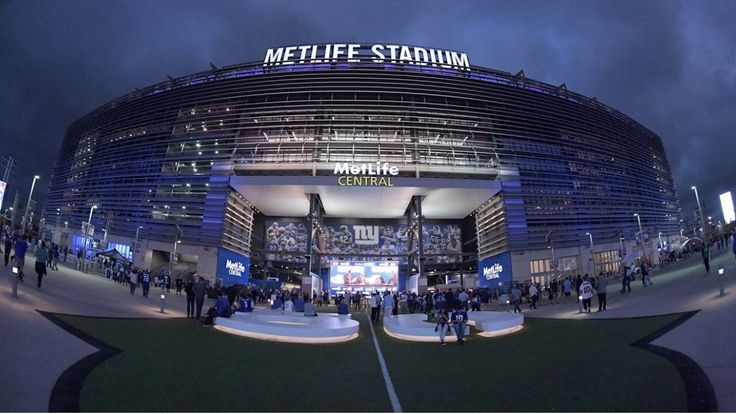
The 2026 FIFA World Cup Final will be played at MetLife Stadium in East Rutherford, New Jersey — officially renamed the New York New Jersey Stadium (NYNJ Stadium) for the duration of the tournament. This name change is standard FIFA policy, designed to avoid conflicts with tournament sponsors by replacing corporate branding with a neutral geographical identity.
MetLife Stadium is located at the Meadowlands Sports Complex, approximately 8 miles west of Midtown Manhattan. It is the largest venue in the entire 2026 World Cup and the only stadium hosting eight matches — more than any other host city in the tournament. The Final on July 19 is the crown jewel of those eight fixtures.
FIFA President Gianni Infantino captured the significance of the selection perfectly: “From the opening match at the iconic Estadio Azteca to the spectacular final in New York New Jersey, players and fans have been at the core of our extensive planning for this game-changing tournament.”
New Jersey Governor Phil Murphy was equally enthusiastic: “Name a team or a country and I guarantee you this — they will have a built-in fan base on either side of the Hudson River.” With the most populous metropolitan area in the United States as its backdrop, MetLife Stadium is a fitting home for the Final of the most-watched sporting event on Earth.
A Brief History of MetLife Stadium
MetLife Stadium opened in 2010, built on the site of the legendary Giants Stadium at the Meadowlands Sports Complex. Construction cost $1.6 billion, making it the most expensive stadium in the United States at the time. The same architectural firm and contractor — EwingCole and Skanska — who built it in 2010 have returned to oversee its World Cup renovations, a fitting full-circle moment.
The stadium is the shared home of two NFL franchises — the New York Giants and the New York Jets — and its design reflects that dual identity. The Giants wanted a traditional, rustic aesthetic; the Jets preferred something sleek and contemporary. The result is a striking fusion: limestone-style stonework and exposed steel alongside glass facades and modern metalwork. The stadium also features illuminated LED lighting inspired by Munich’s Allianz Arena — glowing blue for Giants games and green for Jets games. For the World Cup, the colours will belong to football.
Its track record of hosting mega-events is second to none:
- Super Bowl XLVIII (2014) — the first Super Bowl held outdoors in a cold-weather city
- Copa América Centenario Final (2016) — the last time a major international football final was held here
- Record-breaking concerts — Taylor Swift, Beyoncé, and Ed Sheeran have all performed to sold-out crowds
- Arsenal vs Manchester United (2023) — a preseason match that drew 82,262 fans, a soccer attendance record at the venue
The 2026 World Cup Final will be the most significant chapter yet in this stadium’s remarkable story.
MetLife Stadium Capacity
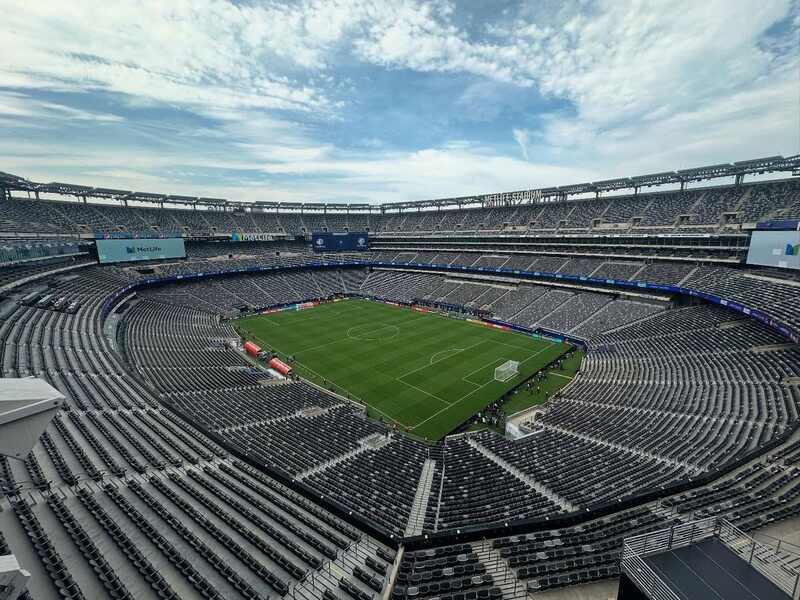
MetLife Stadium holds 82,500 spectators for NFL events, split across three tiers:
| Tier | Seats |
|---|---|
| Lower Bowl | 33,346 |
| Middle Tier | 21,323 |
| Upper Tier | 27,897 |
| Total | 82,500 |
For World Cup matches, capacity is reduced to approximately 75,000 following the removal of 1,740 corner seats to accommodate FIFA’s required pitch dimensions. Those seats have been replaced with a modular system, allowing easy reconfiguration between football and American football configurations.
World Cup Renovations and Upgrades
Hosting a World Cup Final demanded significant investment. MetLife Stadium has undergone a comprehensive transformation:
Field Expansion FIFA requires a larger playing surface than standard NFL dimensions allow. The stadium underwent a two-phase renovation — widening the east side in 2024 and the west side in 2025 — to meet FIFA’s specifications. Between 4 and 10 rows of corner seats were removed to create the necessary space.
Natural Grass Installation One of the most dramatic changes is the pitch itself. MetLife’s artificial turf has been completely replaced with Tahoma 31 bermudagrass, grown over 10 months at Carolina Green Turf Farm near Charlotte, North Carolina. Installation began on May 7, 2026, using approximately 20 truckloads of sod. The grass rests on a two-foot layer of sand over the existing infrastructure, supported by a full irrigation system, backup water tanks, and a vacuum ventilation layer to regulate drainage and surface temperature.
Infrastructure Upgrades New security systems, updated surveillance technology, fresh entrances, and enhanced crowd management systems have all been installed to meet FIFA’s international standards. Irrigation systems and HVAC units ensure the pitch stays in perfect condition throughout the tournament’s summer heat.
Premium Facilities
The fan experience at MetLife Stadium goes far beyond the pitch. The venue boasts:
- 200+ luxury suites with premium views and dedicated service
- Multiple club seating areas, including the EY Coaches Club, Corona Beach Club, West Mezzanine Club, Commissioners Club, and MetLife 50 Club
- Dedicated club lounges designed by the David Rockwell Group
- Expansive concourses with extensive food, beverage, and merchandise options
- State-of-the-art LED and video technology throughout the bowl
For a World Cup Final crowd of 75,000 fans from across the globe, the stadium is built to deliver an experience as memorable as the match itself.
Why FIFA Selected MetLife Stadium for the Final
The decision to award the World Cup Final to MetLife Stadium was not made lightly. FIFA evaluated every venue in the tournament before making its selection, and several powerful factors set NYNJ Stadium apart:
Scale and Prestige With a capacity exceeding 82,500, MetLife is the largest stadium in the 2026 tournament. A World Cup Final demands grandeur, and no venue in the competition matches it for sheer size and presence.
The New York Metropolitan Advantage New York City is the media capital of the world. International broadcasters, global press, dignitaries, and corporate partners converge on the city naturally, making it the ideal hub for an event of this magnitude. The stadium’s proximity to the city — just 8 miles from Midtown — was a decisive factor in FIFA’s thinking.
Proven Event Management MetLife Stadium has a long and distinguished history of hosting high-pressure, high-profile events — Super Bowls, international football finals, and record-breaking concerts. FIFA had every confidence in the venue’s ability to manage the logistics of the world’s biggest sporting occasion.
Transport and Accessibility Sitting at the heart of the most connected region in the United States, the stadium offers unparalleled access to hotels, restaurants, airports, and entertainment. NJ Transit — named the most outstanding public transportation system in the US in 2023 — runs directly to the stadium, making it accessible to fans arriving from every corner of the globe.
Economic Legacy The World Cup is projected to generate over $2 billion in economic impact for the New York–New Jersey region and support approximately 14,000 jobs. Hosting the Final multiplies that legacy, delivering long-term benefits for communities on both sides of the Hudson River.
2026 World Cup Matches at MetLife Stadium
MetLife Stadium will host a total of eight matches during the tournament, culminating in the historic World Cup Final on July 19, 2026. The venue hosts more matches than any other city in the tournament — covering the group stage, knockout rounds, and the Final itself.
| Match | Date | Kick-off (ET) | Teams | Stage |
|---|---|---|---|---|
| 7 | Sat, Jun 13 | 6:00 PM | Brazil 🇧🇷 vs Morocco 🇲🇦 | Group C |
| 17 | Tue, Jun 16 | 3:00 PM | France 🇫🇷 vs Senegal 🇸🇳 | Group I |
| 41 | Mon, Jun 22 | 8:00 PM | Norway 🇳🇴 vs Senegal 🇸🇳 | Group I |
| 56 | Thu, Jun 25 | 4:00 PM | Ecuador 🇪🇨 vs Germany 🇩🇪 | Group E |
| 67 | Sat, Jun 27 | 5:00 PM | Panama 🇵🇦 vs England 🏴 | Group L |
| 77 | Tue, Jun 30 | 5:00 PM | TBD | Round of 32 |
| 91 | Sun, Jul 5 | 4:00 PM | TBD | Round of 16 |
| 104 | Sun, Jul 19 | 3:00 PM | TBD | 🏆 Final |
How to Reach MetLife Stadium
Getting to MetLife Stadium on World Cup matchdays requires advance planning — but the good news is that the New York–New Jersey region offers some of the best public transport options in North America.
By Train — The Best Option
The NJ Transit Meadowlands Rail Line is the fastest and most convenient way to reach the stadium. The Meadowlands station is located directly beside MetLife Stadium, making it a seamless journey. NJ Transit has been ramping up its capacity and staffing specifically for World Cup 2026, and for the Final, it will be running at its highest-ever frequency.
By Bus
Multiple bus routes serve the Meadowlands Sports Complex:
- NJ Transit Route 353 — direct service to Meadowlands Sports Complex
- Coach USA Route 351 — also serves the Meadowlands area
- Official FIFA shuttle buses — running from Port Authority Bus Terminal and Midtown East in New York City, and from a pick-up point in Clifton, New Jersey
Use NJ Transit’s ‘Plan Your Trip’ tool at njtransit.com to map your exact route from your accommodation.
By Car
Fans wishing to drive can access MetLife Stadium via major New Jersey highways. However, on World Cup matchdays — and especially for the Final — road congestion and parking demand will be extreme. Public transport is strongly recommended. If driving is necessary, arrive several hours early and plan your exit route in advance.
New for 2026: MetLife Transitway
A brand new bus rapid transit system — the MetLife Transitway — is opening in 2026 specifically to handle the increased demand generated by the World Cup. This system provides high-capacity, frequent service and is designed to significantly reduce journey times and congestion around the stadium on matchdays.
Getting There from New York City
For fans based in Manhattan or elsewhere in New York City, the journey to MetLife Stadium is straightforward:
- Take the subway or walk to a NJ Transit connection point (Penn Station is the main hub)
- Board the NJ Transit Meadowlands Rail Line toward Meadowlands Station
- Alight at Meadowlands — the stadium is steps away
The entire journey from Midtown Manhattan can take as little as 30–40 minutes by train, making it one of the most accessible World Cup Final venues in the tournament’s history.
Conclusion
MetLife Stadium — the New York New Jersey Stadium for this tournament — is the perfect host for football’s greatest occasion. It has the size, the history, the infrastructure, and the iconic New York backdrop to deliver a World Cup Final that will be remembered for generations.
From its $1.6 billion construction and two Super Bowl bids to its meticulous transformation for the 2026 tournament, this stadium has earned its moment. On July 19, 2026, when the final whistle blows and a new world champion is crowned, it will be here — under the New Jersey sky, with the Manhattan skyline shimmering in the distance — that football history is made.
Whether you are there in the stands, watching from the Fan Festival at Liberty State Park, or tuned in from the other side of the world, the New York New Jersey Stadium will give the 2026 FIFA World Cup Final the stage it deserves.

I’m James Ritter, a sports enthusiast. I’ve played sports since school, and now I enjoy writing about them. My goal is to inspire aspiring athletes through stories of success and determination. I believe anyone can achieve greatness with the right guidance. I aim to make a positive impact on the sports community by sharing stories and insights, connecting my love for sports and writing. Join me on this journey of inspiration for all sports lovers.